A subscription product sounds attractive when you want a side business: build software once, then charge for continued access. The difficult part is giving people a reason to keep paying while keeping the work manageable alongside your main job.
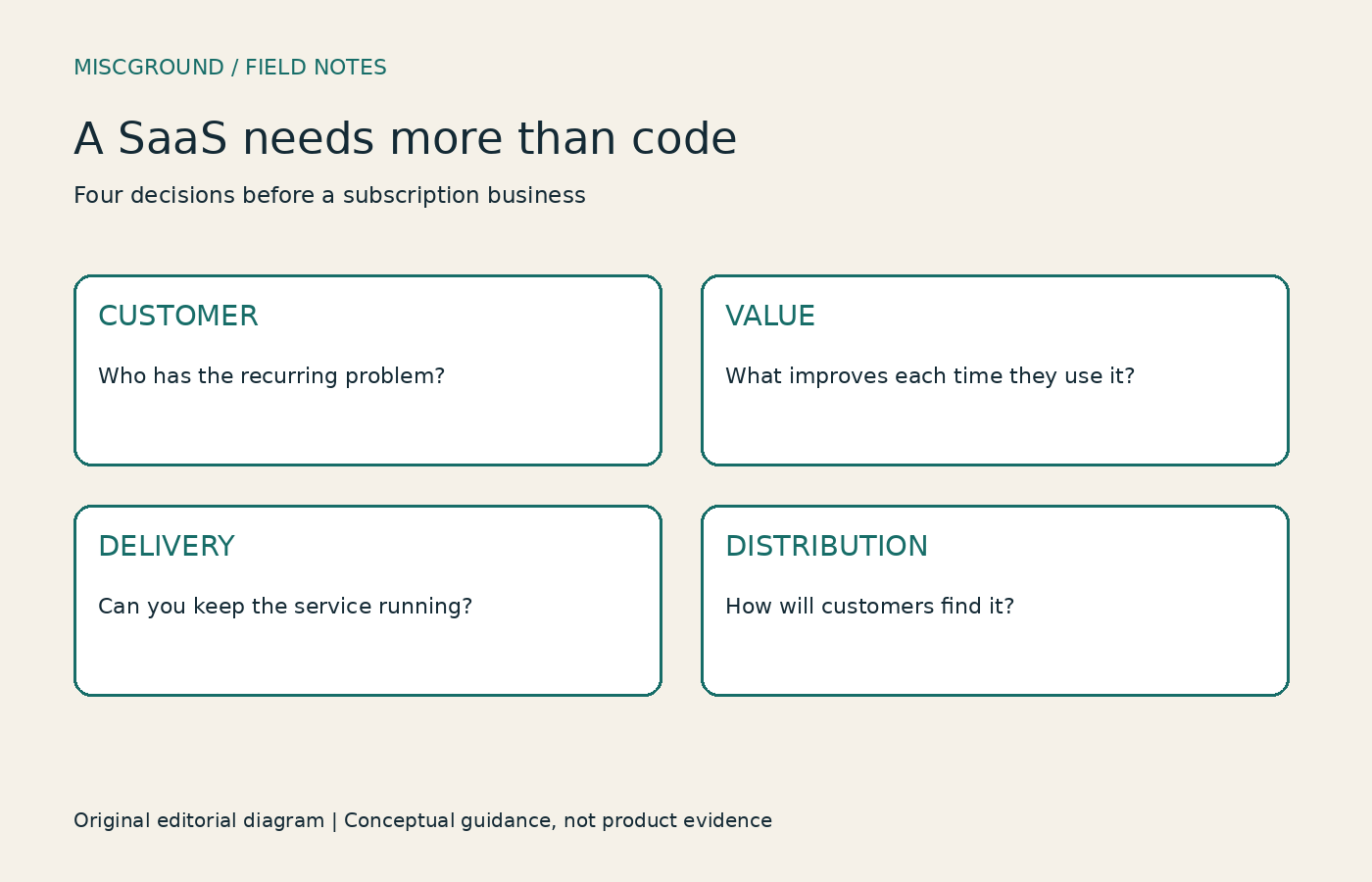
This is a research-based planning guide, not a personal account of launching a profitable SaaS. Start by writing down the customer, the recurring problem, and the smallest useful outcome. Those three decisions shape nearly everything else.
Choose a recurring problem
SaaS means software delivered as an ongoing service. A subscription is easier to explain when the customer repeatedly needs the result: organizing appointments, tracking projects, or preparing a recurring report. A task someone completes once may suit a one-time purchase or a service instead.
Describe one specific customer and one frustrating workflow. “Software for small businesses” leaves too many decisions open. “A weekly report that helps a cleaning company see unfilled appointments” gives you something concrete to investigate. This is a hypothetical example, not evidence that this market wants another product.
Ask potential customers how they handle the task today, what breaks, and whether fixing it is a priority. Compliments about an idea do not establish willingness to pay. The SBA's business-planning guidance treats demand, alternatives, and pricing as separate research questions; your plan should do the same.
Budget for operation, not only development
A working prototype is the start of the expense list. Consider hosting, storage, email delivery, monitoring, payment processing, customer support, and backups. If you use an AI API, account for usage per customer rather than assuming one flat software bill.
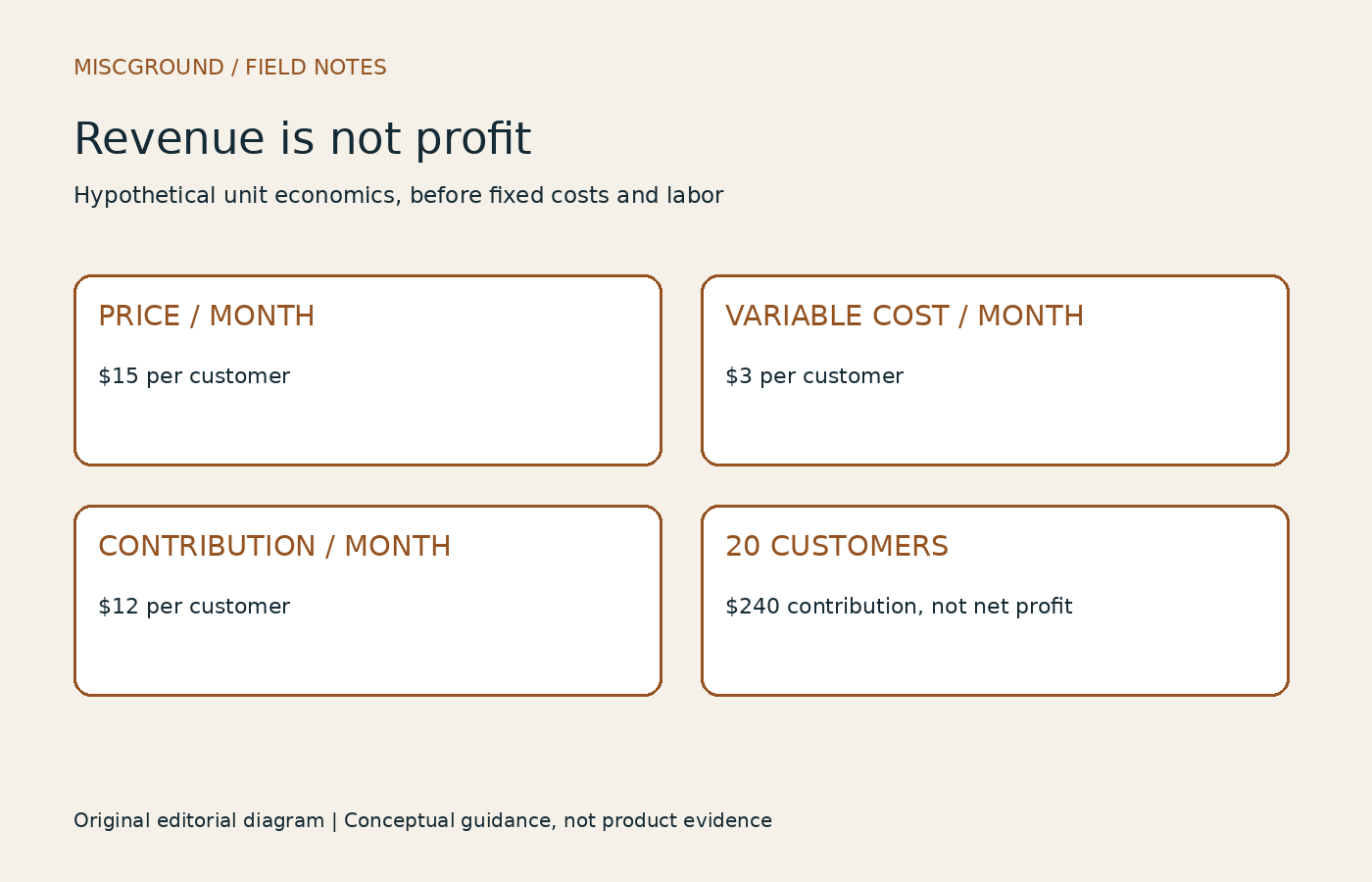
Original editorial diagram. Figures are hypothetical, not business results.
Separate fixed monthly costs from costs that grow with use. A useful planning formula is: contribution per customer equals subscription revenue minus variable servicing costs. Fixed expenses must still come out of the total contribution, and your time is not free simply because you do the work yourself.
Use an explicitly hypothetical example: at $15 per month and $3 in variable costs, contribution is $12 per customer before fixed expenses, taxes, refunds, and your labor. Twenty customers would contribute $240, not $300 of profit. Replace those assumptions with real provider quotes before making a spending decision.
Keep the first version supportable
Choose one complete workflow instead of many incomplete features. A customer should be able to start, get the promised result, and understand what to do when something fails. Accounts, billing, data export, and deletion may be less exciting than the headline feature, but they affect whether the service can be trusted.
Set a support channel and response window you can actually maintain. Decide how you will handle failed payments, interruptions, and cancellation. Before collecting sensitive customer data, understand the obligations that apply to your customers and locations; a generic policy copied from another site cannot establish compliance.
Decide how you will reach the first customers
A product does not come with distribution. Pick a reachable audience and a credible way to demonstrate the result. That might be a focused community, direct conversations, or a useful article answering the exact problem your software addresses. Respect each channel's rules and avoid treating unsolicited promotion as a substitute for customer research.
Measure whether people complete the core task and return when they next need it. Signups alone can hide a product that nobody uses. Keep notes on cancellations and support questions; they can explain why a feature-rich product still feels difficult.
Give the experiment a stopping point
Before building, set your own budget, weekly time allowance, and review date. Define what evidence would justify another round of work: paid use, repeated use, or a clear problem that customers actively ask you to fix. There is no universal customer count that proves a business will succeed.
A SaaS side hustle is worth exploring when you can identify an ongoing need, reach the people who have it, and deliver the service consistently. Write that operating plan first. The prototype should test the plan, not replace it.
Source
- U.S. Small Business Administration: Plan your business — market research and business-planning framework. Accessed October 31, 2026.
Image note: The cover and in-article diagram were created for this article. No stock photograph or actual product screen is included.