A monthly baby guide is most useful when it helps you notice your child, prepare for the next stage, and bring clear questions to a health visit. It becomes less helpful when it turns every birthday into a deadline for a new skill.
This research-based first-year overview uses CDC developmental guidance. It does not add personal parenting experiences that have not been shared. Children develop at different rates, but a concern is still worth discussing rather than dismissing as “every baby is different.”
How to read the months
CDC milestone checklists cover specific ages, including 2, 4, 6, 9, and 12 months during the first year. They do not assign a new diagnostic checklist to every intervening month. CDC describes milestones as skills that at least 75% of children can do by the listed age; these checklists are not a substitute for standardized developmental screening.
The table below is an editorial plan for observing and supporting your baby each month. Only the rows explicitly marked as CDC checkpoints describe examples from those age checklists. Activity suggestions in other months are not additional developmental deadlines.
| Month | What to focus on | A practical thing to prepare or discuss | |---|---|---| | 1 | Learn your baby's signals during feeding, settling, and interaction | Keep questions about feeding, growth, and settling for your baby's clinician; keep the daily routine simple | | 2 — CDC checkpoint | Notice responses to faces and voices, early smiles, and head lifting during tummy time | Offer short, supervised opportunities for interaction and awake floor play | | 3 | Watch how familiar interactions change between checklists | Repeat a simple song or face-to-face game and note your baby's responses | | 4 — CDC checkpoint | Notice cooing, steadier head control, and reaching or holding a toy | Choose easy-to-hold, age-appropriate toys and discuss any movement concerns | | 5 | Reassess the spaces and objects within reach | Look again for small objects, cords, and items that could fall; do not assume yesterday's reach is today's limit | | 6 — CDC checkpoint | Notice reaching, sound exchanges, rolling from tummy to back, and supported sitting using the hands | Offer safe floor space and ask your clinician about the next stage of daily care | | 7 | Continue observing emerging skills without inventing a seven-month deadline | Keep a brief note of new sounds, play, and movement to share at visits | | 8 | Make the environment work for a child who may move or reach differently | Recheck accessible furniture and low storage; choose a few suitable play objects rather than buying a whole new set | | 9 — CDC checkpoint | Notice sitting without support, varied babbling, and looking for an object dropped out of sight | Play a simple hiding game and share questions about communication or movement | | 10 | Observe how your baby explores and communicates during familiar routines | Describe actions in simple words and make space for your baby to respond | | 11 | Review the home and the questions you want to raise at the first-birthday visit | Record examples of gestures, play, and movement instead of comparing only with another child | | 12 — CDC checkpoint | Notice gestures such as waving, putting an object into a container, and pulling up to stand | Bring observations and concerns to the clinician; independent walking is not required by this CDC checkpoint |
Use toys appropriate for your child's age and abilities. Stock photographs in this article are illustrative and are not a safety guide for selecting particular toys.
What you need is often simpler than a shopping list
A new month does not automatically require a new purchase. A safe place for supervised play, a few suitable objects, books, and an adult who responds to the baby can support many everyday interactions. Choose what helps your actual routine instead of assuming a product is necessary because it is marketed for an age bracket.
For early interactions, talk during familiar tasks, pause to let your baby respond, and repeat things they enjoy. Later, simple container play and hiding games can create opportunities to explore. Do not turn play into a repeated test. The purpose is engagement and observation, not training a baby to perform a checklist on demand.
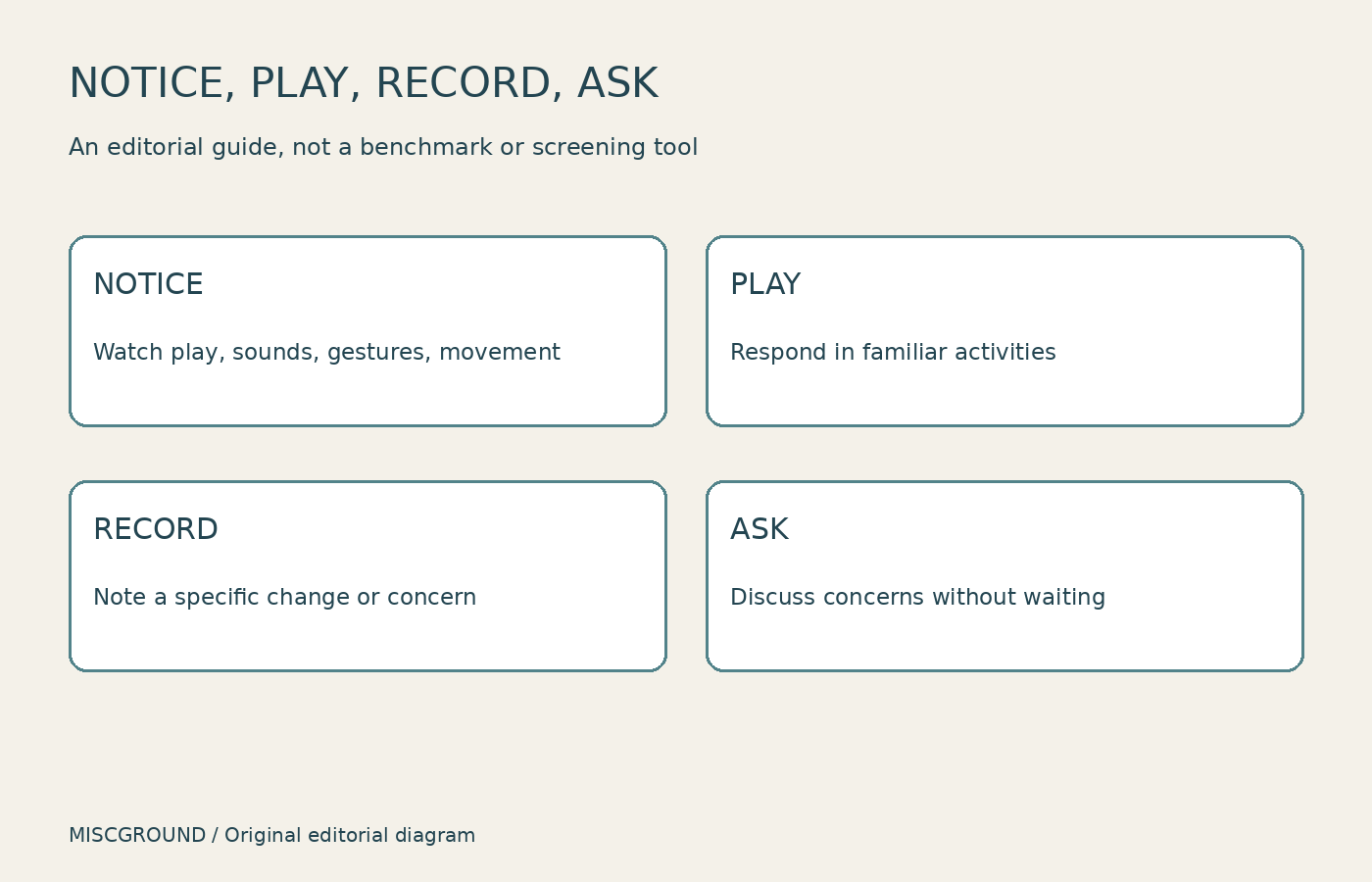
Original editorial reminder based on CDC's monitoring approach; not a screening tool.
Keep useful notes without tracking everything
Write down a new skill or a specific concern in plain language: what happened, when you noticed it, and whether you have seen it more than once. If a behavior worries you, a short recording may help you describe it to the clinician when appropriate. Protect your child's privacy when storing or sharing it.
At a visit, ask a direct question. “I have not noticed this response yet; should we check it?” gives the clinician more information than “Is my baby behind?” Mention if your child was born prematurely and ask how to use the checklists appropriately for your child's history.
When to ask instead of waiting for next month
CDC recommends acting early if a child is missing one or more milestones, loses a previously acquired skill, or you have another concern. Contact the child's clinician, explain what you have noticed, and ask about developmental screening. Do not wait for the next milestone page to provide permission to bring it up.
If concerns remain, ask about a specialist evaluation and your area's early-intervention services. A checklist can organize a conversation, but it cannot diagnose a delay or rule one out on its own.
The most useful monthly habit is to observe, interact, make the environment appropriate, and ask clear questions. That gives you a way to follow your baby's development while leaving room for individual differences.
Sources and image note
CDC resources checked November 2, 2026:
Cover: Childrens Toys / Burst, illustrative stock photograph used under the license shown on the source page. Body image is an original editorial diagram. Neither image is evidence of a particular child's development.