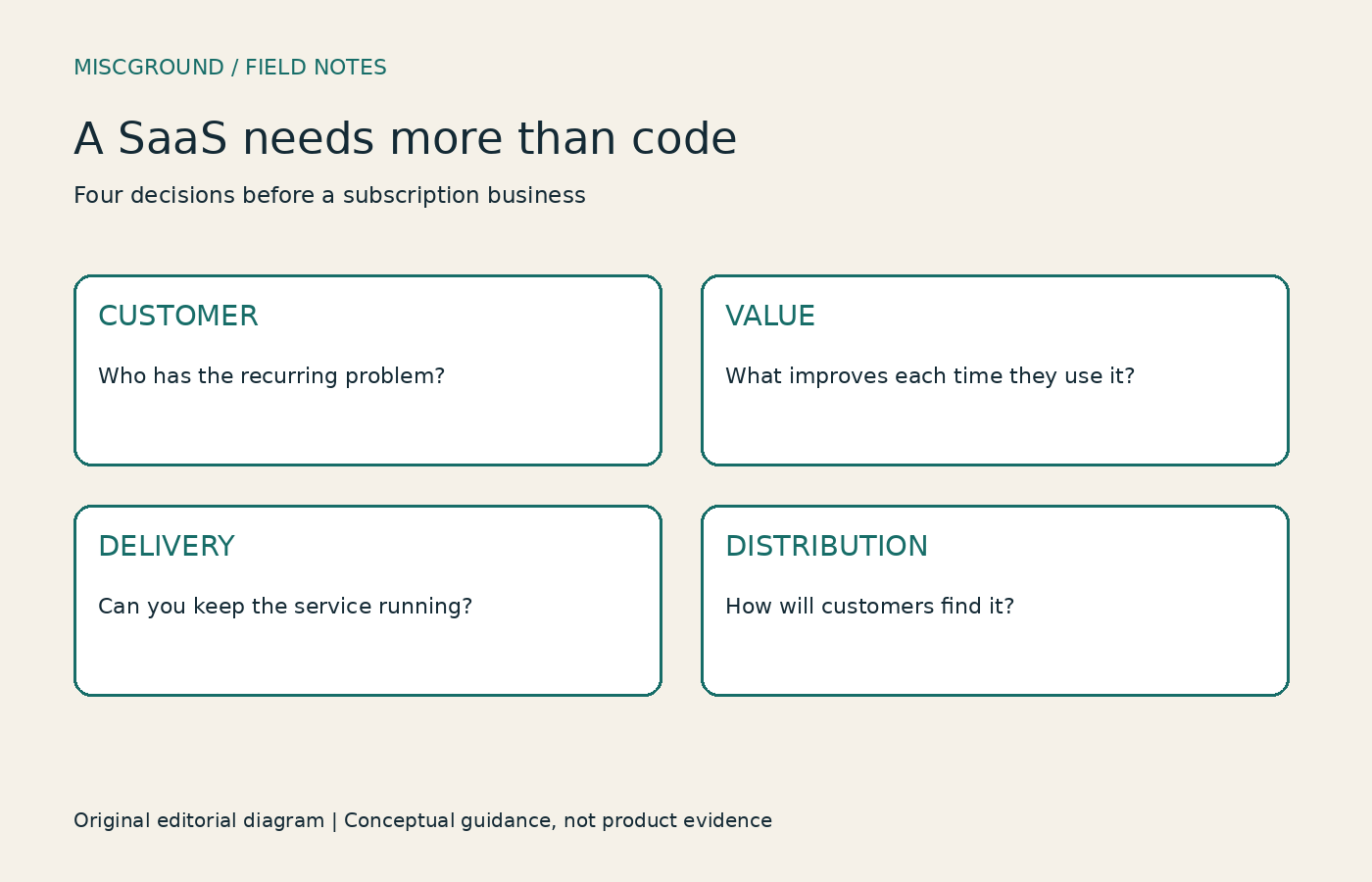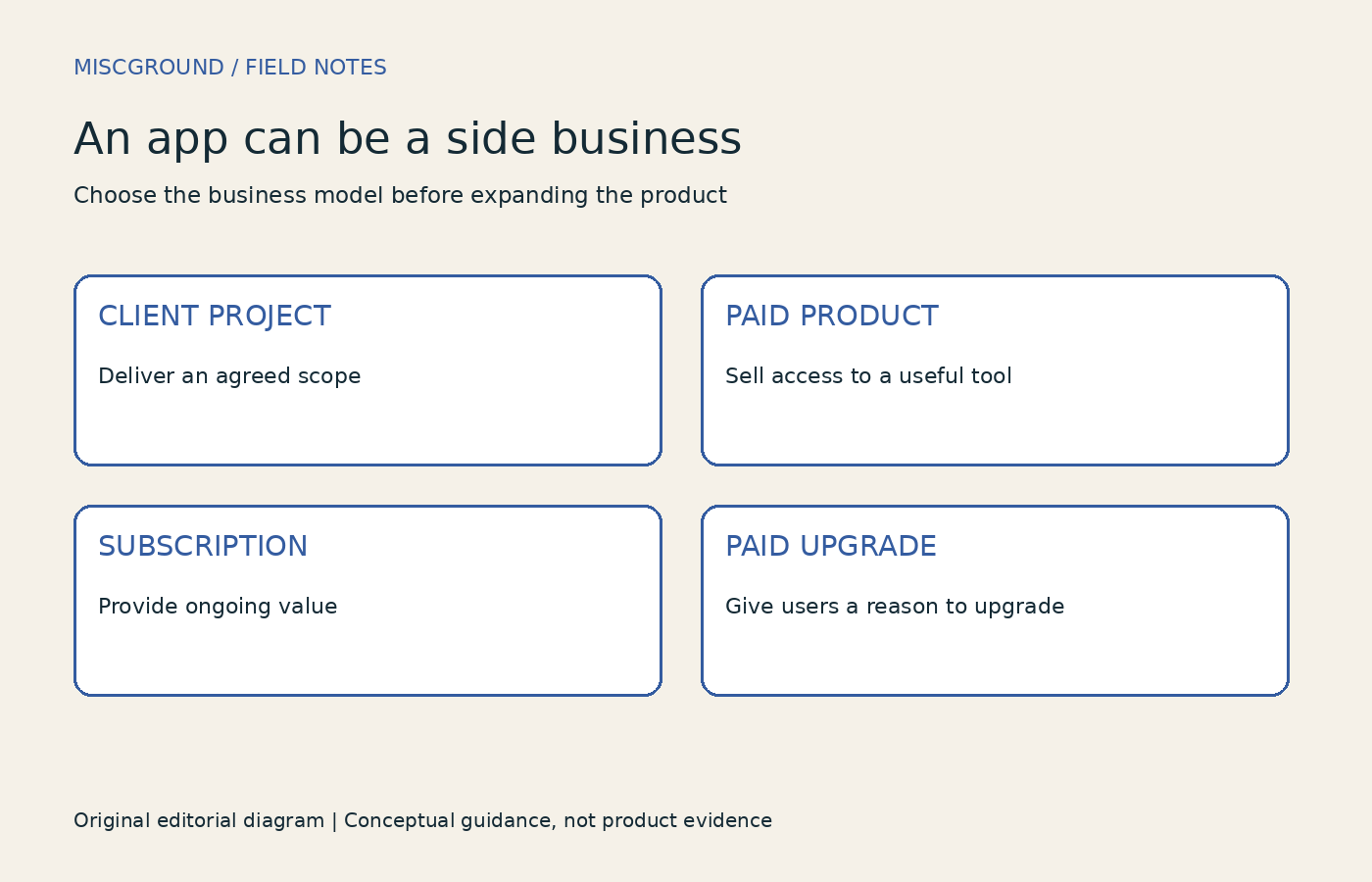
An app can become a side business, but finishing the code does not answer the business question. Someone must find it, understand its value, and have a reason to pay. You must also be able to maintain it after the initial excitement wears off.
This is a planning guide, not a claim of personal app revenue. The useful starting point is a small problem and a realistic delivery model, rather than a promise that AI makes app income easy.
Decide what kind of business you want
There are several ways app development can produce revenue, and they create different responsibilities.
| Model | What the customer buys | What you need to plan | |---|---|---| | A custom app for one client | A defined project and possibly maintenance | Scope, handoff, revisions, and support | | A paid app | Access to a product | Distribution, purchase experience, and updates | | A subscription | Continued access to ongoing value | Retention, billing, availability, and support | | A free app with paid extras | An optional upgrade | A useful free experience and a clear reason to upgrade |
Advertising is another possibility, but it requires an audience and introduces additional design and privacy decisions. Do not assume a small number of downloads will generate worthwhile income. None of these models guarantees a return.
Make the first useful version smaller
Write the app's job in one sentence. A hypothetical example is “help a tennis group collect availability and agree on a match time.” The first version could cover one group and one scheduling flow. It does not need a social network, rankings, payments, and a marketplace to answer whether people find scheduling easier.
Sketch the steps before choosing a framework. Who enters information? What happens when someone makes a mistake? What result makes the task complete? If a shared spreadsheet solves the problem adequately, investigate what your app would improve before investing in a replacement.
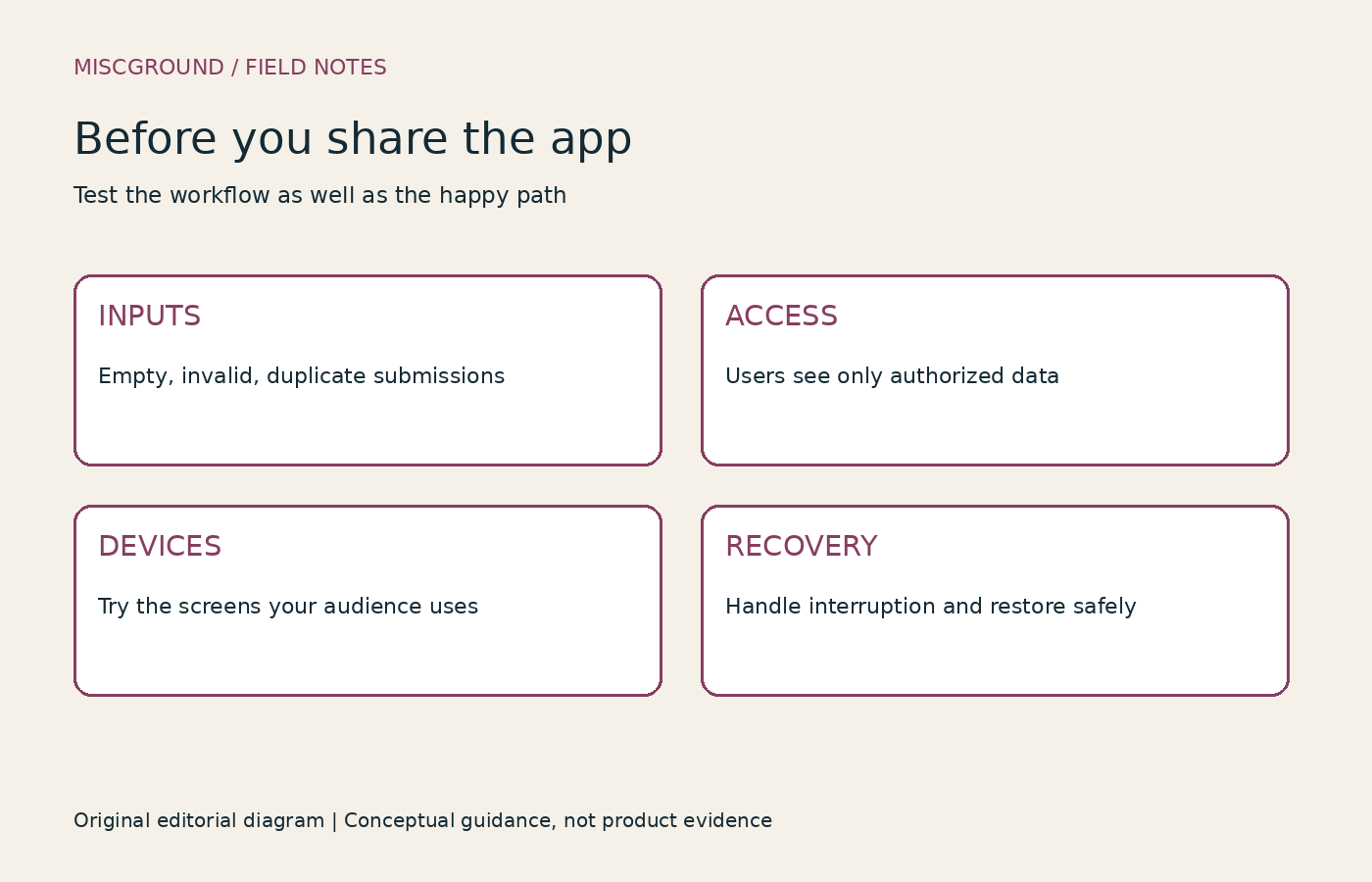
Original editorial diagram; not an app screenshot or evidence of a finished product.
Choose a delivery format that fits the task
A browser-based app may be enough for a workflow users open from a link. A native mobile app may be appropriate when the experience depends on device capabilities or platform integration. The right choice depends on the actual requirements and the people using it.
Before choosing a store-distributed app, check that store's current enrollment, review, payment, and privacy requirements directly. This guide does not quote current fees or promise approval. A web app also needs hosting, access controls, data handling, and ongoing maintenance; putting it in a browser does not remove those responsibilities.
Use AI to help you build, then verify the result
AI-assisted development can help draft components, explain errors, and explore implementation options. Treat generated code as a proposal you need to inspect. A plausible explanation does not establish that authentication, calculations, or data access work correctly.
Test the complete workflow with realistic mistakes: empty inputs, interrupted connections, duplicate submissions, and a user trying to access another user's information. Verify on the devices your audience uses. Keep credentials out of client-side code and retain a version you can restore if an update breaks the app.
If a critical area is beyond your ability to review, make the scope smaller or obtain qualified help. Shipping a simple tool you understand is easier to support than shipping a complex one whose failures you cannot diagnose.
Price the work as well as the software
List development time, recurring services, distribution costs, support, and maintenance. For client work, define what is included and how additional requests will be handled. For a product, separate revenue from profit and account for the costs of acquiring and serving customers.
The SBA's planning framework is useful here: describe the customer, the offering, the route to a sale, and the expenses. Those questions apply whether the deliverable is an app, a service, or both.
Test with people before expanding
Give a small group a specific task to complete and watch where they struggle. Ask what they currently use and why they would switch. Someone saying an app looks nice is different from using it again or paying for it.
Choose a review date and decide what you need to learn by then. If people do not return, investigate the problem before adding features. App development can become a side hustle when the useful outcome, payment model, and maintenance workload fit together. Start with a small version that lets you check all three.
Source
- U.S. Small Business Administration: Plan your business — business planning and customer research. Accessed October 31, 2026.
Image note: The cover and in-article diagram were created for this article. No stock photograph or actual product screen is included.